Tart Cherry for Muscle Recovery After Exercise
By Amanda Bryne9 min read
Does tart cherry help muscles recover after exercise? The clearest answer from the research is about strength. A 2026 scoping review of 28 clinical trials on Montmorency tart cherry found that 7 of the 14 studies measuring strength recovery reported a significant benefit. In the best-known of those, 14 men lost 22 percent of their arm strength over four days after a damaging workout on placebo, and only 4 percent on tart cherry juice.
Soreness and performance are less settled. Six of 22 soreness studies and 4 of 10 performance studies found a significant effect. The rest did not, or found trends that did not reach significance.
So tart cherry is not a magic recovery drink, and nobody serious says it is. But it is one of the few foods with two decades of controlled human trials behind it. Here is what those trials did, in whom, and what they found.
Key studies at a glance
| Study | Who took part | What they took | How long | What the researchers found |
|---|---|---|---|---|
|
Zhu et al. 2026, Frontiers in Nutrition PMID: 42146083 |
28 trials in healthy adults (scoping review) | Montmorency tart cherry in different forms and doses | Varied by trial | 7 of 14 strength studies and 6 of 22 soreness studies found a significant benefit |
|
Hill et al. 2021, Int J Sport Nutr Exerc Metab PMID: 33440334 |
14 studies pooled (meta-analysis) | Tart cherry supplements | Varied by study | Moderate benefit for strength recovery, small benefit for soreness and inflammation markers, no effect on creatine kinase |
|
Daab et al. 2026, Sports Medicine Open PMID: 41945263 |
19 trials in trained athletes (meta-analysis) | Tart cherry juice | Varied by trial | Faster strength recovery and lower C-reactive protein up to 48 hours; no pooled effect on soreness; certainty very low to moderate |
|
Connolly et al. 2006, Br J Sports Med PMID: 16790484 |
14 male college students | 12 fl oz tart cherry juice blend twice a day | 8 days | Strength loss over 4 days was 4% vs 22% on placebo; less pain |
|
Kuehl et al. 2010, J Int Soc Sports Nutr PMID: 20459662 |
54 healthy runners (36 men, 18 women) | 355 mL tart cherry juice twice a day | 7 days before a relay race plus race day | Pain rose 12 mm vs 37 mm on placebo, on a 100 mm scale |
|
Levers et al. 2015, J Int Soc Sports Nutr PMID: 26578852 |
23 resistance-trained men | 480 mg powdered Montmorency tart cherry in capsules a day | 10 days | Less thigh soreness and a smaller rise in markers of muscle breakdown than placebo |
Why a cherry would do anything for sore muscles
Hard or unfamiliar exercise causes tiny tears in muscle fibers. The body responds with inflammation and a burst of oxidative stress, which is part of how muscle repairs and adapts, but it is also what you feel as stiffness and soreness a day or two later, and what shows up in blood as creatine kinase, interleukin-6 and C-reactive protein.
Montmorency tart cherries are rich in anthocyanins, the pigments that make the fruit red, along with other polyphenols. In lab studies these compounds act as antioxidants and dampen inflammatory signaling. The hypothesis behind every trial below is that taking them around a hard effort softens that inflammatory response enough to speed recovery without blocking it. Processing matters here because heat degrades anthocyanins, which we cover in cold-pressed vs heat-dried tart cherry.
The 2006 Vermont trial: 14 men, 22 percent strength loss versus 4
The study that started the field was published in the British Journal of Sports Medicine by Declan Connolly at the University of Vermont. Fourteen male college students drank 12 fluid ounces of a tart cherry juice blend or a placebo twice a day for eight days. On day four they did two sets of 20 maximal eccentric bicep contractions, the lengthening kind that causes the most damage. Strength, pain, tenderness and resting elbow angle were measured for four days after. Two weeks later they repeated the whole thing with the other drink and the other arm.
Strength loss averaged over the four days was 22 percent on placebo and 4 percent on cherry juice. Pain was also significantly lower on the juice. Muscle tenderness and elbow angle were not different.
The limits: 14 young men, a single arm exercise, and a disclosure that each author held 2.5 percent equity in the juice company. The strength finding has since been repeated by independent labs, which is why it still gets cited.
One of those independent repeats came from London South Bank University in 2011. Bowtell and colleagues gave 10 well-trained men Montmorency cherry juice concentrate or a fruit concentrate placebo for 7 days before and 48 hours after 10 sets of 10 single-leg knee extensions. At 24 hours the cherry group was back to 90.9 percent of its starting strength versus 84.9 percent on placebo, and a blood marker of oxidative damage to proteins rose by 24 percent versus 83 percent. Creatine kinase did not differ, and 10 people is a small trial.
The 2010 marathon study: 20 runners, strength back faster
Glyn Howatson's group at Northumbria University in the UK tested tart cherry juice around a real marathon. Twenty recreational runners took either the juice or a placebo for five days before the race, on race day, and for 48 hours after. The researchers tracked muscle damage (creatine kinase, soreness, isometric strength), inflammation (interleukin-6, C-reactive protein, uric acid), total antioxidant status and markers of oxidative stress.
Isometric strength recovered significantly faster in the cherry group. Interleukin-6, C-reactive protein and uric acid were all lower after the race. Total antioxidant status was about 10 percent higher across all post-supplement measurements. Creatine kinase and soreness, however, were not significantly different between groups. So strength and blood markers moved; how sore the runners felt did not, at least not enough to measure in 20 people.
Running pain: 54 relay runners, 7 days of juice
Soreness did move in a bigger trial from Oregon Health and Science University, published in 2010. Kuehl and colleagues gave 54 healthy runners, 36 men and 18 women averaging 36 years old, either tart cherry juice or a placebo cherry drink in 355 mL bottles twice a day for seven days before a 24-hour relay race and on race day. Each runner covered about 26 km over the day.
Both groups hurt more after the race, but the cherry group's pain rose by 12 mm on a 100 mm scale compared with 37 mm for placebo. That is one of the larger soreness effects in the literature and in a group of normal, non-elite runners. The design was randomized, double-blind and placebo-controlled. The main limit is that pain was self-reported, and the placebo was a cherry-flavored drink rather than nothing at all.
Team sports show a similar pattern. In a 2016 Northumbria University trial, 16 semi-professional soccer players took 30 mL of Montmorency tart cherry concentrate or a placebo twice a day for 8 days, with a long repeated-sprint shuttle test on day 5. Strength, jump height and agility recovered faster and soreness ratings were lower in the cherry group, and IL-6, an early inflammation signal, rose less. Creatine kinase did not differ, and with 8 players per group it is another small study.
Capsules instead of juice: the Texas A&M trials
Almost every early trial used juice or concentrate. In 2015 Levers, Kreider and colleagues at Texas A&M tested powdered Montmorency tart cherry in capsules, published in the Journal of the International Society of Sports Nutrition. Twenty-three healthy, resistance-trained men around 21 years old were matched for squat strength and body composition and randomized to 480 mg a day of powdered tart cherry or a placebo capsule for 10 days, including the lifting day and 48 hours after. The workout was ten sets of ten back squats at 70 percent of their one-rep max.
Quadriceps soreness was lower in the cherry group over time, significantly so in the outer quad at 24 hours and in the inner quad through 48 hours. Blood markers of muscle breakdown, including creatinine and total protein, rose less. Inflammatory markers and oxidative stress markers did not differ between groups. The authors concluded the capsules reduced soreness, strength loss during recovery and markers of muscle catabolism.
A follow-up from the same lab in 2016 gave the same 480 mg capsules to 27 endurance-trained runners and triathletes for 10 days around a half marathon. The cherry group finished 13 percent faster and had lower inflammatory and catabolic markers, though pre-run soreness also happened to be lower in that group, which complicates the recovery comparison. Both trials were double-blind and placebo-controlled, and both used a commercial powder with funding from the cherry industry.
What these two studies establish is that the effect does not depend on drinking juice. A dried powder in a capsule produced measurable changes at a dose far below the juice protocols. What they do not establish is which form or dose works best, because no one has run capsules against juice in the same people.
The 2026 scoping review: all 28 trials side by side
Published in Frontiers in Nutrition, the 2026 scoping review by Zhu, Smith and Cohn is the most complete map of this research. It gathered every clinical trial on Montmorency tart cherry and athletic performance, strength recovery or delayed-onset muscle soreness in healthy adults, 28 in total.
The tally: 7 of 14 strength recovery studies, 6 of 22 soreness studies and 4 of 10 performance studies reported a significant benefit. The authors' summary was that the evidence gives preliminary support for faster recovery of muscle strength, while findings on performance and soreness are mixed. They also noted that most trials were small and short, and called for larger randomized trials and a formal meta-analysis.
Two things to know when weighing it. The review was funded by the Cherry Marketing Institute, which also employed one of the authors, and the funder was involved in design and interpretation. And a scoping review counts studies rather than pooling their numbers, so "7 of 14" tells you how often a benefit was found, not how big it was.
Two meta-analyses do pool the numbers. A 2021 meta-analysis by Hill and colleagues combined data from 14 studies and found a moderate benefit for recovery of strength and power, a small benefit for soreness and for two inflammation markers, C-reactive protein and IL-6, and no effect on creatine kinase. A 2026 meta-analysis in Sports Medicine Open of 19 tart cherry juice trials in trained athletes found faster recovery of maximal strength and lower C-reactive protein up to 48 hours, but no pooled effect on soreness, and rated the certainty of the evidence very low to moderate. So the pooled data point the same way as the tally: strength is the most consistent finding, soreness the least.
What sports dietitians recommend
The Australian Institute of Sport, whose supplement framework is used by sports dietitians worldwide, classifies fruit-derived polyphenols including tart cherry as Group B: emerging or mixed evidence, worth considering in specific situations with individual monitoring. Its fact sheet lists recovery of strength and reduced soreness after damaging or endurance exercise as the outcomes with support, along with preliminary evidence for sleep (see tart cherry for sleep).
The practical protocol it describes: 90 to 200 cherries' worth a day, as juice, concentrate or capsulated powder, in a split dose, for four to seven days before and two to four days after the hard effort. It also gives two cautions. Cherries can have a laxative effect, so trial them outside competition first. And high daily doses of antioxidant and anti-inflammatory compounds may reduce the training adaptations athletes want, so it does not recommend them during ordinary day-to-day training. For an athlete chasing adaptation, that is a reason to use tart cherry around events. For someone over 50 whose goal is to get out of bed without stiffness after a long walk or a day in the garden, the trade-off is different, and daily use is what the comfort and sleep studies tested.
Where Nature Heart fits
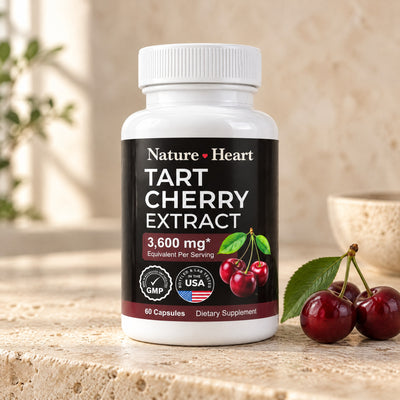
Nature Heart Cold-Pressed Tart Cherry Extract is made from Montmorency tart cherry, the same variety in all 28 trials in the scoping review, in a capsule of dried cherry powder like the Texas A&M studies rather than juice. It is cold-pressed, not heat-dried, and standardized for anthocyanins. Two capsules a day give 3,600 mg equivalent of tart cherry. The capsule is a plain two-piece vegetable capsule, tart cherry is the only ingredient, and every batch is third-party lab tested before it ships. For details on choosing between forms, see capsules vs juice vs gummies.
We will not claim our capsules were in these trials; they were not, and the trials used their own products at their own doses. What we can say is what is in the bottle and that it is covered by a 90-day money-back guarantee, which is long enough to take it through a few hard weeks and judge for yourself. The product page has the full details.
Frequently Asked Questions
Does tart cherry help muscle recovery?
The best-supported effect is faster recovery of muscle strength after hard exercise. A 2026 scoping review of 28 trials found 7 of 14 strength studies reported a significant benefit. In a 2006 crossover trial in 14 men, strength loss over four days after eccentric arm exercise averaged 22 percent on placebo and 4 percent on tart cherry juice. Results for soreness and performance were more mixed.
How much tart cherry do you need for recovery?
The trials used juice at roughly 8 to 12 ounces twice a day, concentrate at 30 mL twice a day, or 480 mg a day of powdered Montmorency capsules, usually starting 4 to 10 days before the hard effort and continuing 2 days after. The Australian Institute of Sport sums this up as 90 to 200 cherries' worth a day in split doses. No head-to-head dose study exists.
Do tart cherry capsules work as well as juice for recovery?
Two trials from Texas A&M used capsules of powdered Montmorency tart cherry at 480 mg a day. In 23 resistance-trained men, soreness and markers of muscle breakdown were lower than placebo after heavy squats. In 27 endurance runners, the capsule group ran a half marathon 13 percent faster and had lower inflammatory markers. The capsules have not been tested directly against juice.
Should you take tart cherry every day if you train?
Maybe not year-round at high doses. The Australian Institute of Sport notes that high doses of antioxidant and anti-inflammatory compounds can blunt the training adaptations you are working for, and recommends using fruit polyphenols around specific hard events rather than every day of normal training. For someone over 50 whose goal is comfort rather than peak adaptation, that trade-off looks different.
Is the tart cherry recovery research independent?
Partly. Several of the trials and the 2026 scoping review were funded by the Cherry Marketing Institute, and the authors of the 2006 trial held equity in the juice company. Other studies, like the 2010 marathon trial and the 2011 knee extension trial, came from university sports science labs. Industry funding does not make a result wrong, but it is a reason to weigh the independent studies a little more.
What studies have been done on tart cherry and muscle recovery?
There are more than two dozen controlled trials. A 2026 scoping review counted 28 trials on Montmorency tart cherry in healthy adults, and a 2021 meta-analysis pooling 14 studies found a moderate benefit for strength recovery and a small one for soreness. A 2026 meta-analysis of 19 juice trials in trained athletes found faster strength recovery but no pooled effect on soreness. The best-known single trials had between 10 and 54 participants.
Sources
- Zhu Y, Smith J, Cohn A (2026). The effect of Montmorency tart cherry consumption on athletic performance and post-exercise recovery in healthy adults: a scoping review. Front Nutr. PMID: 42146083. https://pmc.ncbi.nlm.nih.gov/articles/PMC13173514/
- Connolly DA, McHugh MP, Padilla-Zakour OI, Carlson L, Sayers SP (2006). Efficacy of a tart cherry juice blend in preventing the symptoms of muscle damage. Br J Sports Med. PMID: 16790484. https://pmc.ncbi.nlm.nih.gov/articles/PMC2579450/
- Howatson G, McHugh MP, Hill JA, et al. (2010). Influence of tart cherry juice on indices of recovery following marathon running. Scand J Med Sci Sports. PMID: 19883392. https://pubmed.ncbi.nlm.nih.gov/19883392/
- Levers K, Dalton R, Galvan E, et al. (2015). Effects of powdered Montmorency tart cherry supplementation on an acute bout of intense lower body strength exercise in resistance trained males. J Int Soc Sports Nutr. PMID: 26578852. https://pmc.ncbi.nlm.nih.gov/articles/PMC4647629/
- Kuehl KS, Perrier ET, Elliot DL, Chesnutt JC (2010). Efficacy of tart cherry juice in reducing muscle pain during running: a randomized controlled trial. J Int Soc Sports Nutr. PMID: 20459662. https://pmc.ncbi.nlm.nih.gov/articles/PMC2874510/
- Hill JA, Keane KM, Quinlan R, Howatson G (2021). Tart Cherry Supplementation and Recovery From Strenuous Exercise: A Systematic Review and Meta-Analysis. Int J Sport Nutr Exerc Metab. PMID: 33440334. https://pubmed.ncbi.nlm.nih.gov/33440334/
- Daab W, Bouzid MA, Nassis GP, et al. (2026). Effects of Tart Cherry Juice Supplementation on Recovery from Exercise-Induced Muscle Damage in Athletes: A Systematic Review and Meta-Analysis. Sports Med Open. PMID: 41945263. https://pmc.ncbi.nlm.nih.gov/articles/PMC13057130/
- Bowtell JL, Sumners DP, Dyer A, Fox P, Mileva KN (2011). Montmorency cherry juice reduces muscle damage caused by intensive strength exercise. Med Sci Sports Exerc. PMID: 21233776. https://pubmed.ncbi.nlm.nih.gov/21233776/
- Bell PG, Stevenson E, Davison GW, Howatson G (2016). The Effects of Montmorency Tart Cherry Concentrate Supplementation on Recovery Following Prolonged, Intermittent Exercise. Nutrients. PMID: 27455316. https://pmc.ncbi.nlm.nih.gov/articles/PMC4963917/
- Levers K, Dalton R, Galvan E, et al. (2016). Effects of powdered Montmorency tart cherry supplementation on acute endurance exercise performance in aerobically trained individuals. J Int Soc Sports Nutr. PMID: 27231439. https://pmc.ncbi.nlm.nih.gov/articles/PMC4880859/
- Australian Institute of Sport. Supplements: Group B, Fruit Derived Polyphenols (Cherries, Berries, Blackcurrants and Pomegranate). https://www.ais.gov.au/nutrition/supplements/group_b