Tart Cherry for Sleep: What the Research Says
By Amanda Bryne8 min read

Does tart cherry help you sleep? In three small placebo-controlled trials of tart cherry juice, yes, modestly. Twenty healthy adults slept longer and spent more of their time in bed actually asleep after a week of tart cherry juice concentrate. Eight adults over 50 with insomnia gained about 84 minutes of sleep a night on a sleep lab recording after two weeks of juice. A third study in 15 older adults with insomnia found less time awake in the middle of the night, but no change in how long they slept overall.
The likely reason is that Montmorency tart cherries contain melatonin, the hormone your body releases in the evening to signal that it is time to sleep. Tart cherry is one of the few foods where that has been measured directly.
That is the short version. The longer version matters, because the trials are tiny, the ones that found a benefit all used juice, two newer trials that included capsules found no effect, and the researchers themselves were careful about what they claimed. Here is what each one found.
Key studies at a glance
| Study | Who took part | What they took | How long | What the researchers found |
|---|---|---|---|---|
|
Howatson et al. 2012, Eur J Nutr PMID: 22038497 |
20 healthy adults | Tart cherry juice concentrate daily | 7 days | More melatonin in the urine, longer total sleep and better sleep efficiency than placebo |
|
Pigeon et al. 2010, J Med Food PMID: 20438325 |
15 older adults with chronic insomnia | Tart cherry juice blend daily | 2 weeks | Less time awake after falling asleep and lower insomnia severity; no change in total sleep time |
|
Losso et al. 2018, Am J Ther PMID: 28901958 |
8 adults over 50 with insomnia | 240 mL tart cherry juice twice a day | 2 weeks | 84 more minutes of sleep on a sleep lab recording |
|
Tucker et al. 2024, Nutrients PMID: 39683518 |
34 adults with overweight or obesity and poor sleep | 500 mg Montmorency tart cherry powder capsules 1 hour before bed | 14 days | No significant effect on any sleep or inflammation measure |
|
Hillman et al. 2022, Nutrition and Health PMID: 35790450 |
44 healthy adults | Two 240 mL bottles of Montmorency juice or two capsules of Montmorency powder a day | 30 days | No difference in sleep time or quality vs placebo |
|
Barforoush et al. 2025, Food Sci Nutr PMID: 40964149 |
7 intervention studies (systematic review) | Tart cherry in different forms and doses | Varied by study | 3 studies found better sleep and 3 found higher melatonin; evidence limited and mixed |
Where the melatonin idea comes from
In 2001 a team at the University of Texas Health Science Center, including R. J. Reiter, one of the best-known melatonin researchers, measured melatonin in two tart cherry varieties using liquid chromatography. Montmorency cherries contained about 13.5 nanograms of melatonin per gram of fresh fruit, roughly six times the amount in Balaton cherries. Neither the orchard nor the harvest date changed the number much.
A nanogram is a billionth of a gram, so a serving of cherries delivers a far smaller amount than a melatonin tablet from the pharmacy. The question the later trials tried to answer was whether that small, food-based dose, taken daily, shows up in the body and changes sleep. For the background on the variety itself, see what is Montmorency tart cherry.
The 2012 Northumbria trial: 20 healthy adults, 7 days
The most cited sleep study comes from Glyn Howatson's group at Northumbria University in the UK, published in the European Journal of Nutrition. Twenty healthy men and women took either tart cherry juice concentrate or a placebo for seven days, then after a washout switched to the other. Neither the participants nor the researchers knew which was which at the time. Sleep was tracked two ways: a wrist-worn actigraph that records movement through the night, and sleep questionnaires. Urine was collected over 48 hours to measure the main breakdown product of melatonin.
On the cherry juice, total melatonin in the urine was significantly higher than on placebo. Time in bed, total sleep time and sleep efficiency (the share of time in bed spent asleep) all increased significantly. The timing of the melatonin rhythm did not shift; there was simply more of it.
The limits: 20 people, one week, and these were healthy sleepers rather than people with a sleep problem, so the room for improvement was small to begin with. The gains were measurable but not dramatic. The authors concluded that the juice provided extra melatonin and improved sleep duration and quality in healthy adults, and that it might help with disturbed sleep, which they had not tested.
The 2010 Rochester pilot: 15 older adults with insomnia
Two years earlier, Wilfred Pigeon's sleep lab at the University of Rochester had run the first insomnia trial, published in the Journal of Medicinal Food. Fifteen otherwise healthy older adults with chronic insomnia drank a tart cherry juice blend or a placebo drink for two weeks each, with a two-week break in between. Sleep was tracked with daily diaries and the Insomnia Severity Index, a standard questionnaire.
Compared with their own starting point, the cherry drink improved every sleep measure. Compared with the placebo, the picture was narrower: a significant drop in minutes awake after falling asleep and in insomnia severity, but no advantage for how fast people fell asleep, total sleep time or sleep efficiency. The authors called the effect sizes moderate and in some cases negligible.
They also put the result in context in a way worth repeating. The benefit was similar to or larger than what studies of valerian have shown, and comparable to some melatonin studies, but considerably smaller than sleeping medication or cognitive behavioral therapy for insomnia (CBT-I). If you have real insomnia, CBT-I remains the treatment with the strongest evidence. Tart cherry is a gentle addition, not a replacement.
The 2018 Louisiana study: sleep lab recordings and 84 extra minutes
The third trial, from Louisiana State University and the Pennington Biomedical Research Center, appeared in the American Journal of Therapeutics. It is the only one to use polysomnography, the full overnight recording of brain waves, eye movement and breathing that sleep clinics use. Eleven adults over 50 with insomnia were randomized; three turned out to have sleep apnea and were excluded and referred for treatment. The eight who completed drank 240 mL of tart cherry juice twice a day for two weeks, and a placebo for two weeks, with a washout in between.
On the juice, sleep time measured in the lab increased by 84 minutes, and sleep efficiency on the Pittsburgh Sleep Quality Index improved. Four other questionnaires showed no significant difference. That is a large effect for a food, and also a very small group: eight people.
The study also looked at why. Beyond melatonin, the researchers proposed a second mechanism. Tryptophan is an amino acid the body uses to make serotonin and then melatonin. An enzyme called IDO breaks tryptophan down, and inflammation switches that enzyme on. In the blood of the participants, the ratio of kynurenine to tryptophan (a marker of that breakdown) fell on the juice, as did prostaglandin E2, an inflammatory signal. In lab cells, a cherry compound called procyanidin B-2 blocked IDO in a dose-dependent way. So the idea is that tart cherry may protect the raw material your body needs to make its own melatonin. That part is a hypothesis built on cells and blood markers, not something proven in people.
How it compares with other insomnia options in older adults
In 2020 a group led by Samara at the Technical University of Munich published a network meta-analysis in Acta Psychiatrica Scandinavica that pulled together 53 randomized trials of every available insomnia treatment in people over 65, 6,832 participants in all. Most of those trials tested drugs. Ten tested non-drug approaches, and tart cherry juice was among the handful the authors said performed better than its control, alongside acupressure and mindfulness-based stress reduction.
Two caveats from the same paper. The authors rated overall confidence in the evidence as very low, because most comparisons rested on one or two small trials. And the non-drug studies could only be compared with their own placebos, not head to head with medication. So "tart cherry made the list" is a fair reading; "tart cherry beat the alternatives" is not.
A 2025 systematic review in Food Science and Nutrition that looked only at tart cherry found seven intervention studies. Three reported better sleep, such as longer sleep, higher sleep efficiency or faster sleep onset, and three reported higher melatonin levels. The authors called the evidence limited and mixed, because doses, durations and the people studied varied widely.
The Australian Institute of Sport, which grades supplements for athletes, puts fruit polyphenols including tart cherry in its Group B, meaning emerging or mixed evidence. Its fact sheet notes that tart cherries contain melatonin that may aid sleep, and lists sleep as an area with preliminary support.
What the trials did not test
Three gaps are worth naming. First, every sleep trial that found a benefit used juice: a concentrate taken daily for a week, or 240 mL of juice twice a day for two weeks. The two trials that tested capsules did not find one. At Michigan State, 34 adults with overweight or obesity and poor sleep took 500 mg capsules of Montmorency tart cherry powder or a placebo one hour before bed for 14 days, and no sleep or inflammation measure changed; the authors suggested testing higher doses in this group. At Ohio University, 44 healthy adults took two 240 mL bottles of Montmorency juice, two capsules of Montmorency powder or a placebo every day for 30 days, and sleep time and quality did not differ from placebo with either form. So there is no direct evidence yet that capsules help sleep. Our comparison of capsules, juice and gummies goes through what changes between forms, including sugar, which matters if you are drinking two glasses of juice a day for sleep.
Second, the trials that found a benefit were short, one to two weeks, and small, 8 to 20 people. Nobody knows whether the effect holds at three months or fades. Third, none of them tested a single bedtime dose. They tested daily use and measured sleep after a week or more. If you try tart cherry for sleep, that is the pattern the evidence supports: take it every day, give it at least two weeks, and judge it on how you sleep across a stretch of nights rather than one.
Where Nature Heart fits
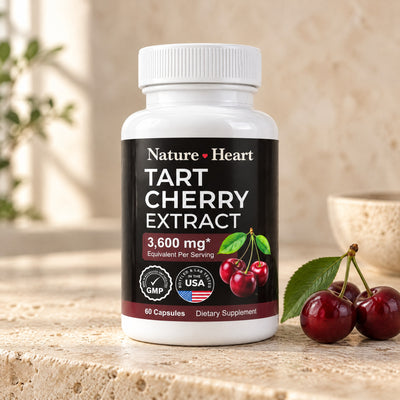
Nature Heart Cold-Pressed Tart Cherry Extract is Montmorency tart cherry, the variety in which melatonin was measured in 2001 and the one used in the 2012 and 2018 sleep trials. It is cold-pressed rather than heat-dried and standardized for anthocyanins, the red pigments that carry much of the fruit's activity. Two capsules a day give 3,600 mg equivalent of tart cherry, with nothing else in the capsule: no sugar, no fillers, no flow agents. For someone who does not want two glasses of juice a day, that is the practical difference. In our October 2026 buyer survey, sleep was one of the top three reasons first-time customers gave for buying, named by 19 percent.
We will be straight about the limit: the sleep studies that found a benefit used juice, and the two capsule trials so far found no effect, so we cannot tell you a capsule has been shown to help sleep. What we can tell you is what is in the bottle, that every batch is third-party lab tested before shipping, and that there is a 90-day money-back guarantee, which is long enough to give it the two weeks the research suggests and then decide. Details are on the product page.
Frequently Asked Questions
Does tart cherry help you sleep?
In three small placebo-controlled trials, yes, modestly. Twenty healthy adults slept longer and more efficiently after seven days of tart cherry juice concentrate. Eight older adults with insomnia gained 84 minutes of sleep a night on a sleep lab recording after two weeks of juice. A third trial in 15 older adults with insomnia found less time awake during the night but no change in total sleep. The effects were real but small, and the groups were tiny.
Why would tart cherry affect sleep?
Montmorency tart cherries contain melatonin, the hormone your body releases in the evening to signal sleep. A 2001 analysis measured about 13.5 nanograms per gram of fresh Montmorency cherries. In the 2012 trial, people who drank the juice had more melatonin metabolites in their urine. A second idea, from the 2018 study, is that a cherry compound called procyanidin B-2 slows the breakdown of tryptophan, an amino acid the body uses to make serotonin and melatonin.
How much tart cherry did the sleep studies use?
The three trials that found a benefit all used juice. The 2012 trial used tart cherry juice concentrate daily for seven days, the 2018 insomnia study used 240 mL of juice twice a day for two weeks, and the 2010 study used a juice blend for two weeks. Two later capsule trials, 500 mg at bedtime for 14 days and two capsules a day for 30 days, found no difference from placebo.
Is tart cherry as effective as a sleeping pill?
No, and the researchers said so. The 2010 insomnia study described the effects as modest, similar to or larger than those seen with valerian and some melatonin studies, but considerably smaller than sleeping medication or cognitive behavioral therapy for insomnia. If you have ongoing insomnia, CBT-I is the treatment with the strongest evidence, and tart cherry is at best a gentle addition.
When should you take tart cherry for sleep?
The trials used daily dosing, and the 2018 study split it into two servings a day. None tested a single bedtime dose, so there is no evidence either way on timing beyond that. Taking it consistently for at least a week or two seems to matter more than the clock, since the 2012 and 2018 studies measured effects after daily use, not after one serving.
What studies have been done on tart cherry and sleep?
About half a dozen small trials. Three placebo-controlled juice trials, in 20 healthy adults, 15 older adults with insomnia and 8 adults over 50 with insomnia, found modest improvements such as longer sleep or less time awake at night. Two later trials that included Montmorency capsules, in 34 adults with overweight or obesity and in 44 healthy adults, found no difference from placebo. A 2025 systematic review of seven studies called the evidence limited and mixed.
Sources
- Burkhardt S, Tan DX, Manchester LC, Hardeland R, Reiter RJ (2001). Detection and quantification of the antioxidant melatonin in Montmorency and Balaton tart cherries (Prunus cerasus). J Agric Food Chem. PMID: 11600041. https://pubmed.ncbi.nlm.nih.gov/11600041/
- Howatson G, Bell PG, Tallent J, Middleton B, McHugh MP, Ellis J (2012). Effect of tart cherry juice (Prunus cerasus) on melatonin levels and enhanced sleep quality. Eur J Nutr. PMID: 22038497. https://pubmed.ncbi.nlm.nih.gov/22038497/
- Pigeon WR, Carr M, Gorman C, Perlis ML (2010). Effects of a tart cherry juice beverage on the sleep of older adults with insomnia: a pilot study. J Med Food. PMID: 20438325. https://pmc.ncbi.nlm.nih.gov/articles/PMC3133468/
- Losso JN, Finley JW, Karki N, et al. (2018). Pilot Study of the Tart Cherry Juice for the Treatment of Insomnia and Investigation of Mechanisms. Am J Ther. PMID: 28901958. https://pmc.ncbi.nlm.nih.gov/articles/PMC5617749/
- Samara MT, Huhn M, Chiocchia V, et al. (2020). Efficacy, acceptability, and tolerability of all available treatments for insomnia in the elderly: a systematic review and network meta-analysis. Acta Psychiatr Scand. PMID: 32521042. https://pubmed.ncbi.nlm.nih.gov/32521042/
- Tucker RM, Kim N, Gurzell E, et al. (2024). Commonly Used Dose of Montmorency Tart Cherry Powder Does Not Improve Sleep or Inflammation Outcomes in Individuals with Overweight or Obesity. Nutrients. PMID: 39683518. https://pmc.ncbi.nlm.nih.gov/articles/PMC11644614/
- Hillman AR, Trickett O, Brodsky C, Chrismas B (2022, print 2026). Montmorency tart cherry supplementation does not impact sleep, body composition, cellular health, or blood pressure in healthy adults. Nutr Health. PMID: 35790450. https://pubmed.ncbi.nlm.nih.gov/35790450/
- Barforoush F, Ebrahimi S, Abdar MK, Khademi S, Morshedzadeh N (2025). The Effect of Tart Cherry on Sleep Quality and Sleep Disorders: A Systematic Review. Food Sci Nutr. PMID: 40964149. https://pmc.ncbi.nlm.nih.gov/articles/PMC12438961/
- Australian Institute of Sport. Supplements: Group B, Fruit Derived Polyphenols (Cherries, Berries, Blackcurrants and Pomegranate). https://www.ais.gov.au/nutrition/supplements/group_b