Why Your Big Toe Hurts at Night (and What People Do About It)
By Amanda Bryne9 min read

A big toe that wakes you at night, hot, swollen and too tender for the weight of the bedsheet, is the classic sign of gout. Gout happens when uric acid, a waste product your body makes from purines, builds up in the blood and forms needle-shaped crystals in a joint. The joint at the base of the big toe is the one it picks most often, and the attacks have a habit of starting in the middle of the night. Other reasons a big toe hurts at night include arthritis in the toe joint itself, a bunion, an injury, or shoes that were too tight all day.
What people do about it: treat the flare early, rest and cool the joint, cut back on beer, sugary drinks and red meat, work on weight, stay active, and some add tart cherry as one option. A first attack, a fever, or a joint that is hot and red should be seen by a doctor, because an infection can look exactly the same.
Key studies at a glance
| Study | Who took part | What they took | How long | What the researchers found |
|---|---|---|---|---|
|
Choi et al. 2015, Arthritis Rheumatol PMID: 25504842 |
724 people with gout, online cohort | Nothing assigned; tracked the hour each attack started | 1 year, 1,433 attacks | Attacks were 2.36 times more likely between midnight and 8 a.m. than between 8 a.m. and 4 p.m. Observational. |
|
Choi et al. 2004, N Engl J Med PMID: 15014182 |
47,150 men with no gout at the start | Their usual diet, food questionnaire every 4 years | 12 years | 730 new cases. Most meat: 41% higher risk. Most seafood: 51% higher. Most dairy: 44% lower. Observational. |
|
Zhang et al. 2012, Arthritis Rheum PMID: 23023818 |
633 people with gout, online cohort | Cherries or cherry extract, self-reported | 1 year | 35% lower risk of an attack after cherries in the 2 days before; 75% lower with cherries plus allopurinol. Observational. |
|
Stamp et al. 2020, Rheumatology PMID: 31891407 |
50 people with gout and high urate | Tart cherry juice concentrate, 7.5 to 30 mL twice a day, or placebo | 28 days | No change in serum urate or in flares at any dose |
|
Zhang et al. 2026, Asia Pac J Clin Nutr PMID: 42242852 |
4 randomized trials, 392 participants (meta-analysis) | Tart cherry vs placebo or usual diet | Varied by trial | Modest drop in serum uric acid; trials disagreed a lot |
|
Jäger et al. 2025, J Diet Suppl PMID: 41247121 |
10 healthy adults | 500 mg standardized tart cherry extract daily, or placebo | 4 weeks | Plasma urate 37.4% lower than on placebo. Small trial. |
The scene at 2 a.m., and why gout picks the big toe
It usually goes like this. You went to bed fine. Somewhere after midnight you wake up because your big toe is on fire. You pull the sheet off it, because even that is too much. The joint at the base of the toe is swollen, shiny, warm to the touch and an angry red, or darker than the skin around it. Putting your foot on the floor is out of the question.
If that sounds familiar, you are describing a gout flare almost word for word. Mayo Clinic describes an attack as sudden, often in the middle of the night, with a joint so tender that the weight of a sheet can feel like too much pressure. The pain tends to be worst within the first 8 to 12 hours. After that, some discomfort can hang around for days or weeks.
Your body makes uric acid when it breaks down purines, which are in your own tissues and in many foods. Normally the kidneys filter it out into urine. When the body makes too much or the kidneys clear too little, uric acid builds up in the blood. At high enough levels it can form sharp crystals in and around a joint, and the immune system reacts to those crystals with inflammation. That reaction is the flare.
The National Institute of Arthritis and Musculoskeletal and Skin Diseases says many people have their first flare in one of their big toes, that flares often start suddenly at night, and that the pain can be bad enough to wake you. Cleveland Clinic says the same: attacks often develop overnight, and a typical flare lasts a week or two. The sources describe the night-time pattern without settling on a single reason for it, so we will not invent one.
The timing itself has been measured. A 2015 Boston University study followed 724 people with gout online for a year and recorded the hour each of their 1,433 attacks began. The risk of an attack between midnight and 8 a.m. was 2.36 times higher than between 8 a.m. and 4 p.m., and the pattern held in people who had no alcohol and little purine in the 24 hours before. It is observational and based on what people reported, so it confirms the night-time pattern without proving why it happens.
Other reasons a big toe hurts at night
Gout is the headline, but not every sore toe is gout. The way the pain behaves tells you a lot.
Arthritis in the toe joint (hallux rigidus). Cleveland Clinic describes this as arthritis at the metatarsophalangeal joint, the knuckle where your big toe meets your foot. It is a slow-building stiffness and ache rather than a sudden explosion, and it tends to hurt more after a long day on your feet. Most people manage it with better-fitting shoes and over-the-counter pain relievers. Osteoarthritis in general can also hurt more at night in later stages, according to NIAMS.
A bunion. The bump on the inside of the foot at the base of the big toe rubs on shoes all day and can throb at night. It does not usually come with a hot, swollen joint.
An injury. A stubbed toe, a dropped can of beans, or a toe that got bent back during a walk can swell and hurt for days. If you remember the moment it happened, that is your answer. If it looks crooked or you cannot put weight on it, get it looked at.
An infection. This is the one that matters. A joint infection can be hot, red and swollen just like gout. Cleveland Clinic says sudden, intense joint pain with swelling and skin discoloration in someone who has not been diagnosed should be seen promptly, because these symptoms can also signal an infection that needs treatment.
Who gets big toe gout, and what sets it off
Mayo Clinic, NIAMS and MedlinePlus list a consistent set of risk factors. Men are more likely to get gout, usually between 30 and 50. Women catch up after menopause. Extra body weight makes the body produce more uric acid and makes the kidneys slower to clear it. Untreated high blood pressure, diabetes, metabolic syndrome, kidney disease and heart disease all raise the risk, as does a family history. Some medicines raise uric acid too, including thiazide diuretics (water pills), low-dose aspirin and some blood pressure drugs. Recent surgery or an injury can bring on an attack.
Then there is what you eat and drink. Mayo Clinic names red meat and organ meats such as liver, purine-rich seafood such as anchovies, sardines, mussels, scallops, trout and tuna, alcohol (mainly beer), and drinks sweetened with fructose. A steak dinner with two beers and a soda is close to a worst-case evening for someone prone to gout. The best-known data on this comes from a 2004 study in the New England Journal of Medicine that followed 47,150 men with no gout for 12 years: those who ate the most meat had a 41 percent higher risk of developing gout, the most seafood a 51 percent higher risk, while the men who ate the most dairy had a 44 percent lower risk. Purine-rich vegetables were not linked to more gout. It was observational and only included men. NIAMS adds that a flare can also be triggered by physical trauma or certain illnesses.
What people do during a flare
The first rule is speed. MedlinePlus says to start gout medicines as soon as possible during a new attack, naming NSAIDs such as ibuprofen or naproxen and colchicine, and to ask a health care provider about the right dose and whether these are safe for you. If this is your first attack, that is a doctor's call, not a pharmacy aisle decision.
Beyond medicine, people do the obvious things. They stay off the foot and keep it up on a pillow. They keep the sheet off the toe. A cold pack wrapped in a towel for ten or fifteen minutes takes the edge off the heat in the joint. They skip the beer and the steak until it settles.
What people do between flares
This is where the real work happens, because a toe that flared once will likely flare again. MedlinePlus lists the lifestyle measures that help prevent attacks: drink less alcohol, especially beer; lose weight and exercise daily; limit red meat and sugary beverages; and eat dairy, vegetables, nuts, legumes, fruit and whole grains. It also notes that coffee and vitamin C supplements may help some people.
Exercise matters more than most people expect. Walking does not cause gout, and regular activity helps with the weight, blood pressure and blood sugar that sit behind it. Thirty minutes most days is the usual target. For a full routine, see 7 daily habits for joint comfort after 50.
Many people also add tart cherry, so here is the honest summary. Tart cherries are rich in anthocyanins, the pigment that makes them red, and the research on uric acid is real but modest. A 2026 meta-analysis in the Asia Pacific Journal of Clinical Nutrition pooled four randomized controlled trials with 392 participants and found a modest reduction in serum uric acid compared with control, with high variation between studies and a call for larger trials. A small placebo-controlled trial in 10 healthy adults found plasma urate fell from 7.01 to 4.39 mg/dL after 4 weeks on a standardized tart cherry extract, while placebo did not drop. Ten people is a pilot. In people who already have gout, the picture splits. A 2012 study of 633 people with gout, followed online for a year, found that eating cherries in the two days before was linked to a 35 percent lower risk of an attack, and 75 percent lower when combined with allopurinol, but it was observational and cannot prove cause. A 2020 randomized trial gave 50 people with gout tart cherry juice concentrate at 7.5 to 30 mL twice a day for 28 days and found no change in serum urate or in flares. We go through all of it in tart cherry and uric acid: what the research says. The short version: tart cherry is one option to layer onto the diet and weight changes, not a replacement for them or for whatever your doctor prescribes.
When to see a doctor
Some of this is urgent and some of it is a regular appointment, so here is the split.
- Same day or emergency: a fever along with a hot, inflamed joint. Mayo Clinic says to seek care immediately, because this can be an infection. Also: a toe that looks crooked after an injury, or sudden swelling of one foot or lower leg with no obvious cause.
- Your first attack: Mayo Clinic says to call your doctor if you have sudden, intense pain in a joint. A diagnosis confirms it is gout and not something else, and gout that goes untreated can lead to worsening pain and joint damage.
- Attacks that are coming back: Cleveland Clinic says to see your provider if flares are becoming more frequent or more severe. There are medicines that lower uric acid long term.
- Lumps under the skin: MedlinePlus says to contact a provider if you develop tophi, which are hard lumps of crystals around joints, on the fingertips, elbows or ears.
Where Nature Heart fits
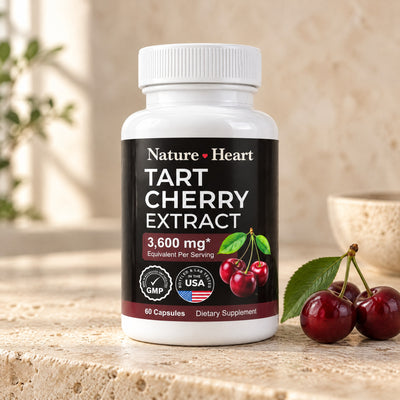
Nature Heart makes one product: Cold-Pressed Tart Cherry Extract. Two vegetable capsules a day give 3,600 mg equivalent of Montmorency tart cherry, cold-pressed rather than heat-dried and standardized for anthocyanins. There is one ingredient and no fillers, and every batch is third-party lab tested before it ships. In our October 2026 buyer survey, uric acid was the reason 31 percent of first-time buyers gave for trying it. Richard R., a verified customer, wrote: "Right now I have gout in my toe, so I started taking 2 cherry supplement capsules a day. I can actually feel the pills fighting the pain. It would flare up for an hour, then stop. Back and forth until the pain was less and less."
That is one person's experience, not a study, and we would rather you read it that way. If your toe woke you up last night, see a doctor first. Then, if you want to add tart cherry to the beer-and-steak changes, a bottle lasts 30 days and comes with a 90-day money-back guarantee.
Frequently Asked Questions
Why does gout attack the big toe at night?
Gout is caused by uric acid crystals forming in a joint, and the joint at the base of the big toe is the one it hits most often. Mayo Clinic, NIAMS and Cleveland Clinic all describe gout attacks as starting suddenly, often in the middle of the night, sometimes badly enough to wake you. The sources describe the pattern but do not settle on one reason for the timing.
How long does a gout flare in the big toe last?
Mayo Clinic says the pain is usually worst within the first 8 to 12 hours, with some discomfort lasting days to weeks afterward. Cleveland Clinic and NIAMS put a typical flare at a week or two, with no symptoms in between. Untreated, flares tend to come back more often and last longer.
Is big toe pain at night always gout?
No. Arthritis in the big toe joint (hallux rigidus), a bunion rubbing in bed, a stubbed or broken toe, or an infection can all hurt at night. Gout stands out because it arrives suddenly, the joint is hot, red and swollen, and it is too tender to touch. A first attack should be checked by a doctor, because an infected joint can look the same.
What foods and drinks make big toe gout worse?
Mayo Clinic and MedlinePlus point to beer and other alcohol, drinks sweetened with fructose, red meat and organ meats, and purine-rich seafood such as anchovies and sardines. MedlinePlus lists dairy, vegetables, nuts, legumes, fruit and whole grains as the foods to lean on.
Does tart cherry help with uric acid?
Studies on tart cherry found modest effects. A 2026 meta-analysis of four randomized trials with 392 participants reported a modest reduction in serum uric acid, with a lot of variation between studies. A small 4-week placebo-controlled trial in 10 healthy adults found plasma urate fell from 7.01 to 4.39 mg/dL on a standardized tart cherry extract. Tart cherry is one option alongside the diet, weight and medication advice from your doctor.
What studies have been done on gout attacks at night?
A 2015 Boston University study followed 724 people with gout online for a year and recorded 1,433 attacks. The risk of an attack between midnight and 8 a.m. was 2.36 times higher than between 8 a.m. and 4 p.m., and the pattern held in people who had no alcohol and little purine the day before. It is an observational study, so it confirms the timing but not the reason for it.
Sources
- Mayo Clinic (2026). Gout: Symptoms and causes. https://www.mayoclinic.org/diseases-conditions/gout/symptoms-causes/syc-20372897
- National Institute of Arthritis and Musculoskeletal and Skin Diseases (2023). Gout Symptoms, Causes, & Risk Factors. https://www.niams.nih.gov/health-topics/gout
- Cleveland Clinic. Gout: What It Is, Symptoms & Treatment. https://my.clevelandclinic.org/health/diseases/4755-gout
- MedlinePlus (2024). Gout. https://medlineplus.gov/ency/article/000422.htm
- Cleveland Clinic (2023). Hallux Rigidus: Symptoms, Causes & Treatment. https://my.clevelandclinic.org/health/diseases/14665-hallux-rigidus
- National Institute of Arthritis and Musculoskeletal and Skin Diseases (2025). Osteoarthritis Symptoms, Causes & Risk Factors. https://www.niams.nih.gov/health-topics/osteoarthritis
- Zhang Z et al. (2026). Tart cherry intake and serum uric acid: Meta-analysis of randomized controlled trials and evidence from network pharmacology. Asia Pacific Journal of Clinical Nutrition 35(3):451-462. PMID: 42242852. https://pmc.ncbi.nlm.nih.gov/articles/PMC13236459/
- Jäger R, Purpura M, Balcombe ST, Godavarthi A, Reddy SA, Vasenina E, Tinsley GM (2025). Effects of Tart Cherry Extract Supplementation on Plasma Urate and C-Reactive Protein Levels in Healthy Adults: a Randomized Controlled Trial. J Diet Suppl. PMID: 41247121. https://www.tandfonline.com/doi/full/10.1080/19390211.2025.2589787
- Choi HK, Niu J, Neogi T, et al. (2015). Nocturnal risk of gout attacks. Arthritis Rheumatol. PMID: 25504842. https://pmc.ncbi.nlm.nih.gov/articles/PMC4360969/
- Choi HK, Atkinson K, Karlson EW, et al. (2004). Purine-rich foods, dairy and protein intake, and the risk of gout in men. N Engl J Med. PMID: 15014182. https://pubmed.ncbi.nlm.nih.gov/15014182/
- Zhang Y, Neogi T, Chen C, et al. (2012). Cherry consumption and decreased risk of recurrent gout attacks. Arthritis Rheum. PMID: 23023818. https://pmc.ncbi.nlm.nih.gov/articles/PMC3510330/
- Stamp LK, Chapman P, Frampton C, et al. (2020). Lack of effect of tart cherry concentrate dose on serum urate in people with gout. Rheumatology (Oxford). PMID: 31891407. https://pmc.ncbi.nlm.nih.gov/articles/PMC10687352/