Tart Cherry and Uric Acid: What the Research Says
By Amanda Bryne10 min read
Does tart cherry lower uric acid? Based on the human studies published so far: sometimes, modestly, and not for everyone. A 2025 placebo-controlled trial in 10 healthy adults found blood urate 37.4 percent lower after four weeks of a standardized tart cherry extract. A 2026 meta-analysis that pooled four randomized trials found a small average reduction. And a 2020 trial in 50 people with gout found no change at all.
That spread is the real answer. Tart cherry is not a drug, and the research on uric acid is still small. But it is real research in real people, and worth reading properly before you spend money or get your hopes up.
Below is each study in plain language: who was in it, what they took, what happened, and what the study could not tell us.
Key studies at a glance
| Study | Who took part | What they took | How long | What the researchers found |
|---|---|---|---|---|
|
Jäger et al. 2025, J Diet Suppl PMID: 41247121 |
10 healthy adults | 500 mg standardized tart cherry extract daily, or placebo | 4 weeks | Plasma urate 37.4% lower and CRP 23% lower than on placebo. Small trial. |
|
Martin and Coles 2019, Curr Dev Nutr PMID: 31037275 |
26 overweight or obese adults | 240 mL (8 oz) tart cherry juice daily, or placebo drink | 4 weeks | Serum urate 19.2% lower |
|
Zhang et al. 2026, Asia Pac J Clin Nutr PMID: 42242852 |
4 randomized trials, 392 participants (meta-analysis) | Tart cherry vs placebo or usual diet | Varied by trial | Modest drop in serum uric acid; trials disagreed a lot |
|
Stamp et al. 2020, Rheumatology PMID: 31891407 |
50 people with gout and high urate | Tart cherry juice concentrate, 7.5 to 30 mL twice a day, or placebo | 28 days | No change in serum urate or in flares at any dose |
|
Zhang et al. 2012, Arthritis Rheum PMID: 23023818 |
633 people with gout, online cohort | Cherries or cherry extract, self-reported | 1 year | 35% lower risk of an attack after cherries in the 2 days before. Observational. |
|
Singh et al. 2020, J Clin Rheumatol PMID: 32453288 |
84 people with gout, online pilot | Cherry extract 3,600 mg a day, or diet changes with a dietitian | 9 months | Flares per month fell from 0.36 to 0.22 in the cherry group vs their own baseline. No placebo group. |
First, what uric acid is and why people watch it
Uric acid is a waste product your body makes when it breaks down purines, compounds found in your own cells and in foods like red meat, organ meat, shellfish and beer. Most of it leaves through the kidneys. When the blood level stays high, doctors call it hyperuricemia. Your lab report shows a reference range next to the number, and anything above it gets flagged.
High urate matters because the excess can form needle-shaped crystals in and around joints. The big toe is the classic spot. When the immune system reacts to those crystals you get a gout flare: a hot, swollen, painfully tender joint, often overnight. If that sounds familiar, our article on why your big toe hurts at night covers the warning signs that need a doctor.
Cherries have a long folk reputation for gout. The studies below are the attempts to test that reputation with blood draws instead of stories.
The 2025 extract trial: 10 healthy adults, 500 mg a day
The most recent and the most striking result comes from a randomized, double-blind, placebo-controlled crossover trial published in the Journal of Dietary Supplements (Jäger, Tinsley and colleagues, 2025). Ten healthy adults, six men and four women averaging 35 years old, took either 500 mg of a standardized tart cherry extract powder or a placebo every day for four weeks. After a two-week washout they switched.
Blood was drawn on day one at two, four and eight hours after the first dose, and again on day 28. A single dose changed nothing. After four weeks of daily use, plasma urate was 37.4 percent lower than on placebo, a drop of about 2.6 mg/dL, and C-reactive protein (CRP, a general marker of inflammation in the blood) was 23 percent lower.
The limits are important. Ten people is a very small group. They were healthy, with no gout and no stated urate problem, so the result tells you little about someone whose number is already high. The extract came from European tart cherries, not Montmorency, and was standardized, so a generic cherry powder is not the same thing. And several authors work for companies in the supplement industry, which does not make the data wrong but is worth knowing.
A trial in people closer to the ones who worry about this number points the same way. In 2019 Martin and Coles tested tart cherry juice in 26 overweight and obese adults, 240 mL (8 oz) a day or a placebo drink for four weeks each, in a randomized crossover. Serum urate came down 19.2 percent on the juice. Still a small group, and juice rather than an extract.
Not every capsule study agrees. A 2024 Texas A&M trial gave 25 adults with mildly elevated uric acid capsules of 960 mg Montmorency tart cherry powder or placebo with a purine-heavy soup, then two capsules a day for a week. Compared with placebo, tart cherry did not change the uric acid response to the meal, either on day one or after the week. It was a short proof-of-concept study, and it tested a single purine load, not long-term levels.
The 2026 meta-analysis: four trials, 392 people
A meta-analysis pools several trials to get a bigger picture than any one of them can give. In 2026 a group at Southeast University in Nanjing published one on tart cherry and serum uric acid in the Asia Pacific Journal of Clinical Nutrition.
They found four randomized controlled trials that compared tart cherry with a placebo or a usual diet and reported serum uric acid, eight comparisons in all, 392 participants in total. Pooled together, tart cherry intake was linked to a modest reduction in uric acid. In statistical terms the standardized mean difference was minus 0.22, which is a small effect, and the confidence interval only just cleared zero. The authors also flagged substantial heterogeneity, meaning the trials disagreed with each other quite a bit.
Their conclusion was that tart cherry "may modestly lower" serum uric acid, that the evidence is thin and inconsistent, and that larger trials are needed. That is about as honest a summary as the field has.
The gout study everyone cites: 633 people, 35 percent fewer attacks
If you have read anything about cherries and gout, you have probably seen this one. In 2012 Yuqing Zhang and colleagues at Boston University published a study in Arthritis and Rheumatism that followed 633 people with diagnosed gout online for a year. Each time they had a flare, they reported what they had eaten and taken in the two days before it, and the same information for calm periods.
Eating cherries in a two-day window was associated with a 35 percent lower risk of a gout attack compared with not eating them. Cherry extract showed a similar pattern (odds ratio 0.55). People who ate cherries and also took allopurinol, the standard urate-lowering drug, had 75 percent fewer attacks than during periods with neither.
What this study is not: a trial. Nobody was assigned to cherries. People chose when to eat them and reported it from memory. That design, called case-crossover, is good at spotting patterns but cannot prove cherries caused the difference. It also did not measure uric acid at all. It measured attacks.
The trial that found nothing: 50 people with gout, 28 days
This is the study to read if you want to stay honest. In 2020 Stamp and colleagues at the University of Otago, with Zhang from the Boston study as a co-author, published a randomized trial in Rheumatology. Fifty people with gout and elevated serum urate, half on allopurinol and half on nothing, were assigned to placebo or to tart cherry juice concentrate at 7.5, 15, 22.5 or 30 mL twice a day for 28 days.
Blood was drawn at baseline, at one, three and five hours after the first dose, and on days 1, 3, 7, 14, 21 and 28. The result: no dose of cherry concentrate had any significant effect on serum urate, on urate leaving in the urine, or on the number of flares over the 28 days. Allopurinol use made no difference to that. One adverse event out of 24 reported was judged possibly related to the cherry.
The authors' conclusion was blunt. If cherry concentrate helps with gout flares over a longer period, it is probably not by lowering urate. For anyone with gout, this trial is the strongest evidence we have on the question, and it says tart cherry did not move the number in four weeks.
A longer study looked at flares rather than the number. In a 2020 pilot by Jasvinder Singh's group at the University of Alabama at Birmingham, 84 people with gout were randomized online to cherry extract capsules at 3,600 mg a day or to diet changes guided by a dietitian, for nine months. In the cherry group, flares per month fell from 0.36 at the start to 0.22, and the share who had any flare fell from 98 to 56 percent. In the diet group the share with any flare also fell, from 98 to 65 percent. There was no placebo group, so these are before-and-after comparisons, and the study was designed to test whether such a trial could be run, not to prove an effect.
Older and smaller: fresh cherries and marathon runners
Two more studies fill in the picture. In 2003 a USDA group led by Jacob tested fresh cherries in 10 healthy women aged 22 to 40. After an overnight fast they ate two servings, about 280 grams, of Bing sweet cherries. Five hours later plasma urate had dropped from about 214 to 183 micromoles per liter, and urate in the urine went up, peaking at three hours. CRP trended down but not significantly. Note these were sweet cherries, not tart, and this was a single meal in young healthy women.
A 2026 trial gives a reason to be careful with single-meal results like that. Lamb and Lynn at Sheffield Hallam University gave 12 healthy adults 250 mL of tart cherry juice (made with 30 mL of concentrate) on one day and plain water on another. Uric acid shifted over the following hours on both days, with no difference between the cherry juice and the water. The authors' point: urate naturally drifts through the day, usually downward, so short studies without a control drink may have credited the cherry for part of that normal rhythm.
In 2010 Glyn Howatson's group at Northumbria University gave 20 recreational marathon runners either Montmorency tart cherry juice or a placebo for five days before the race, on race day and for two days after. The study was about recovery, but uric acid was one of the inflammation markers they tracked, and it was lower in the cherry group after the marathon, along with CRP and interleukin-6. Twenty people, a secondary outcome, and a very specific situation. Still, it points the same direction as the 2025 trial.
What this adds up to
Put the studies side by side and a pattern shows. In healthy adults, tart cherry (or sweet cherry) has lowered blood urate in small studies, sometimes by a lot, sometimes by a little. In people who already have gout, one proper trial found nothing in four weeks, while a large observational study found fewer attacks. The pooled estimate across randomized trials is small and shaky.
A few practical points follow from that. Tart cherry is not a substitute for urate-lowering medication, and the gout data say the fewest attacks came from cherries plus allopurinol, not cherries alone. If you want to know whether it does anything for your number, get a blood test, take it daily for a month or two, and test again. Single doses did nothing in the trial that checked. And the form matters: the studies used juice concentrate, fresh fruit, a standardized extract and dried powder, at wildly different amounts, which is one reason the results scatter. The active compounds are mostly anthocyanins, the pigment that makes the cherry red, and heat processing degrades them. Our guide on cold-pressed versus heat-dried tart cherry explains why that matters when you are choosing a product.
Where Nature Heart fits
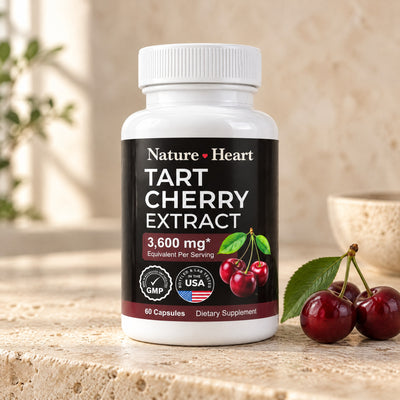
Nature Heart Cold-Pressed Tart Cherry Extract is made from Montmorency tart cherry, the variety used in most of the human research. It is cold-pressed rather than heat-dried and standardized for anthocyanins. Two capsules a day give 3,600 mg equivalent of tart cherry, the capsule is a plain two-piece vegetable capsule filled with cherry powder, and tart cherry is the only ingredient. Every batch is third-party lab tested before it ships, and there is a 90-day money-back guarantee, which is long enough to do the before-and-after blood test described above. In our October 2026 buyer survey, uric acid was the main reason to buy for 31 percent of first-time customers.
One of those customers, Maria R., wrote that her uric acid test "came back at a 9, very high," that she took the capsules for a month instead of starting medication, and that her retest came back at 3. That is one person's report, not a study, and the gout trial above is a reminder that not everyone will see that. If your number is high, work with your doctor. If you want to try tart cherry alongside that, you can read more on the product page or in our guide on how to choose a tart cherry supplement.
Frequently Asked Questions
Does tart cherry lower uric acid?
In some studies, modestly. A 2025 placebo-controlled trial in 10 healthy adults found blood urate 37.4 percent lower after four weeks of a 500 mg standardized tart cherry extract. A 2026 meta-analysis of four randomized trials found a small average reduction with a lot of variation between trials. A 2020 trial in 50 people with gout found no change. The honest summary is a small, inconsistent effect.
How much tart cherry did the uric acid studies use?
It varied a lot. The 2025 trial used 500 mg of a standardized extract powder once a day for four weeks. The gout trial used tart cherry juice concentrate at 7.5 to 30 mL twice a day for 28 days. The 2003 study used two servings of fresh sweet cherries, about 280 grams, in one sitting. No single dose has been shown to be the right one.
Can tart cherry replace gout medication?
No. The one randomized trial in people with gout found no effect on serum urate or on flares over 28 days. The large observational study that linked cherries to fewer gout attacks found the lowest risk when cherries were combined with allopurinol, not instead of it. Keep taking what your doctor prescribed and talk to them before changing anything.
How long does it take to see a change in uric acid?
The studies that found a drop measured it after four weeks of daily use, or in one case five hours after a large serving of fresh cherries. Single doses of the extract did nothing in the 2025 trial. If you want to know whether it does anything for you, the only reliable way is a blood test before and after a month or two.
Were the studies done on Montmorency tart cherry?
Mostly, but not all. The gout trial and the marathon study used Montmorency juice concentrate. The 2025 extract trial used a European tart cherry extract. The 2003 urate study used Bing sweet cherries. Tart cherries are generally richer in anthocyanins than sweet cherries, so results do not transfer one to one.
Sources
- Jäger R, Purpura M, Balcombe ST, et al. (2025). Effects of Tart Cherry Extract Supplementation on Plasma Urate and C-Reactive Protein Levels in Healthy Adults: a Randomized Controlled Trial. J Diet Suppl. PMID: 41247121. https://pubmed.ncbi.nlm.nih.gov/41247121/
- Zhang Z, Feng Z, Yan W, et al. (2026). Tart cherry intake and serum uric acid: Meta-analysis of randomized controlled trials and evidence from network pharmacology. Asia Pac J Clin Nutr. PMID: 42242852. https://pmc.ncbi.nlm.nih.gov/articles/PMC13236459/
- Zhang Y, Neogi T, Chen C, et al. (2012). Cherry consumption and decreased risk of recurrent gout attacks. Arthritis Rheum. PMID: 23023818. https://pmc.ncbi.nlm.nih.gov/articles/PMC3510330/
- Stamp LK, Chapman P, Frampton C, et al. (2020). Lack of effect of tart cherry concentrate dose on serum urate in people with gout. Rheumatology (Oxford). PMID: 31891407. https://pmc.ncbi.nlm.nih.gov/articles/PMC10687352/
- Jacob RA, Spinozzi GM, Simon VA, et al. (2003). Consumption of cherries lowers plasma urate in healthy women. J Nutr. PMID: 12771324. https://pubmed.ncbi.nlm.nih.gov/12771324/
- Howatson G, McHugh MP, Hill JA, et al. (2010). Influence of tart cherry juice on indices of recovery following marathon running. Scand J Med Sci Sports. PMID: 19883392. https://pubmed.ncbi.nlm.nih.gov/19883392/
- Martin KR, Coles KM (2019). Consumption of 100% Tart Cherry Juice Reduces Serum Urate in Overweight and Obese Adults. Curr Dev Nutr. PMID: 31037275. https://pmc.ncbi.nlm.nih.gov/articles/PMC6483050/
- Gonzalez DE, Kendra JA, Dickerson BL, et al. (2024). Effects of Acute and One-Week Supplementation with Montmorency Tart Cherry Powder on Food-Induced Uremic Response and Markers of Health: A Proof-of-Concept Study. Nutrients. PMID: 39408358. https://pmc.ncbi.nlm.nih.gov/articles/PMC11478512/
- Singh JA, Green C, Morgan S, et al. (2020). A Randomized Internet-Based Pilot Feasibility and Planning Study of Cherry Extract and Diet Modification in Gout. J Clin Rheumatol. PMID: 32453288. https://pmc.ncbi.nlm.nih.gov/articles/PMC8664374/
- Lamb KL, Lynn A (2026). Tart cherry juice has no acute effects on uric acid, vascular function and inflammation: A randomised crossover trial. Nutr Health. PMID: 41604330. https://pubmed.ncbi.nlm.nih.gov/41604330/